




Adapted from a story originally published on Magdalene
For Muh. Agus Syam, advancing gender equality does not begin with large campaigns or public platforms. It starts with conversations, relationships, and the communities closest to him.
Growing up in Majene, Agus had long been active in youth initiatives and community organising. Yet despite his commitment to social issues, his participation in Magdalene’s Youth Leadership Camp, part of the #WaveForEquality campaign, marked a turning point in his journey as a gender equality advocate.
Through the Community of Practice (CoP) formed out of the Youth Leadership Camp, Agus joined a diverse group of young leaders from different backgrounds who were learning from one another’s experiences. The CoP broadened his understanding of gender issues, particularly from a male perspective, while strengthening his skills in advocacy and campaigning.
Just as importantly, it helped him think more carefully about how gender equality messages could be communicated in ways that reflected the realities, values, and cultures of different communities.
This combination of learning, peer exchange, and practical application is central to how Communities of Practice help participants build the competence and confidence to become stronger advocates.
Applying learnings back home
Returning to Majene, Agus began applying those lessons in his own community. Rather than relying on generic messages, he looked for ways to connect conversations about equality to people’s everyday experiences. He shared information through social media, webinars, and discussions with local youth, while also exploring how local Bugis cultural values and traditions could be used to open conversations about gender roles, caregiving, and participation.
One challenge repeatedly surfaced in these conversations. Many young women wanted to participate in community activities but could not obtain permission from their parents. Agus recalled hearing women say: “My mother doesn’t allow me to go out. There’s nothing we can do; we just stay at home.”
Recognising these barriers, Agus worked with his friends at PIK-R Marasana to create alternative opportunities that young women could access from home. Together they organised poetry and essay-writing competitions under the theme “Celebrating Differences, Strengthening Equality.” The activities received positive responses and enabled more young people to engage with gender equality issues in ways that were accessible and safe for them.
Inviting more people in
The skills Agus gained through the CoP also helped him bring others into advocacy. By learning how to tailor messages to different audiences and cultural contexts, he became better equipped to encourage peers to engage with gender equality issues. Similar approaches emerged among fellow youth leaders.
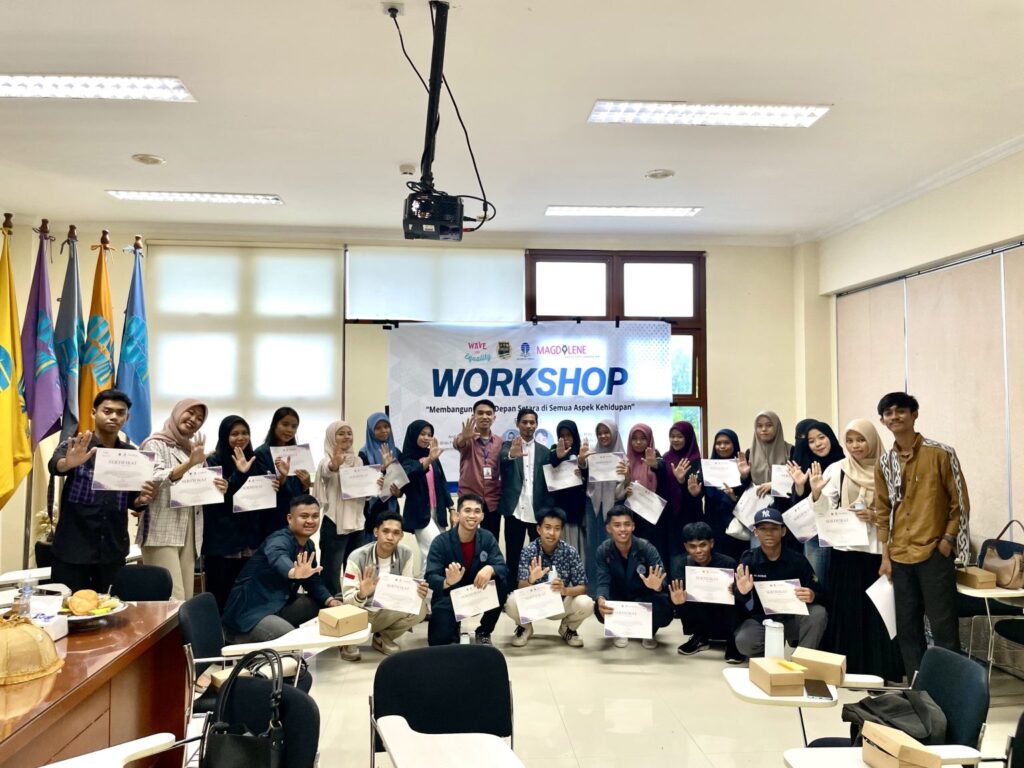
After completing his Youth Fellowship with Magdalene’s Wave for Equality initiative, Agus (centre) continues to share what he has learned with gender advocates in his community. (Photo courtesy of Muh. Agus Syam)
During the #BerbagiBeban Content Creator Fellowship, for example, participant Maswandi, who engaged in Agus’ local CoP, created content explaining the sharing of caregiving responsibilities through Bugis cultural concepts while highlighting the role men can play in care work. Together, these examples demonstrate how members of a Community of Practice can adapt shared learning to their own contexts and expand the circle of advocates around them.
From the barbershop to the classroom
For Agus, however, advocacy is not limited to organised activities. In the barbershop he runs, he deliberately welcomes customers regardless of gender. “If they are turned away [in other places], they won’t be turned away here,” Agus said.
The gazebo beside the shop has also become an informal space where he and other young men discuss social issues, including gender equality. Rather than confronting people aggressively when sexist views arise, he chooses a gentler and more reflective approach. “I don’t judge them right away. I ask, ‘Oh, so that’s how you see it?’ Then little by little, I explain why that isn’t right,” Agus said.
His advocacy has not always been easy. At times he has faced criticism, teasing, and changes in friendships because of his views. Yet the confidence gained through learning alongside other advocates has helped him continue.
As a teaching assistant at an elementary school, he also looks for opportunities to challenge limiting assumptions among children and their families. When one student doubted whether she could pursue athletics while wearing a hijab, he encouraged her to keep pursuing her goals. “You can do it, even while wearing a hijab,” Agus recalled telling this student.
Agus’s story illustrates how CoPs can help transform commitment into action. Through learning, peer support, and practical opportunities to apply new skills, he strengthened his capacity as an advocate, adapted gender equality messages to his local context, and created opportunities for others to join the conversation.
His journey demonstrates how change can begin in everyday spaces and how one advocate can help make gender equality more visible, credible, and actionable for others.