




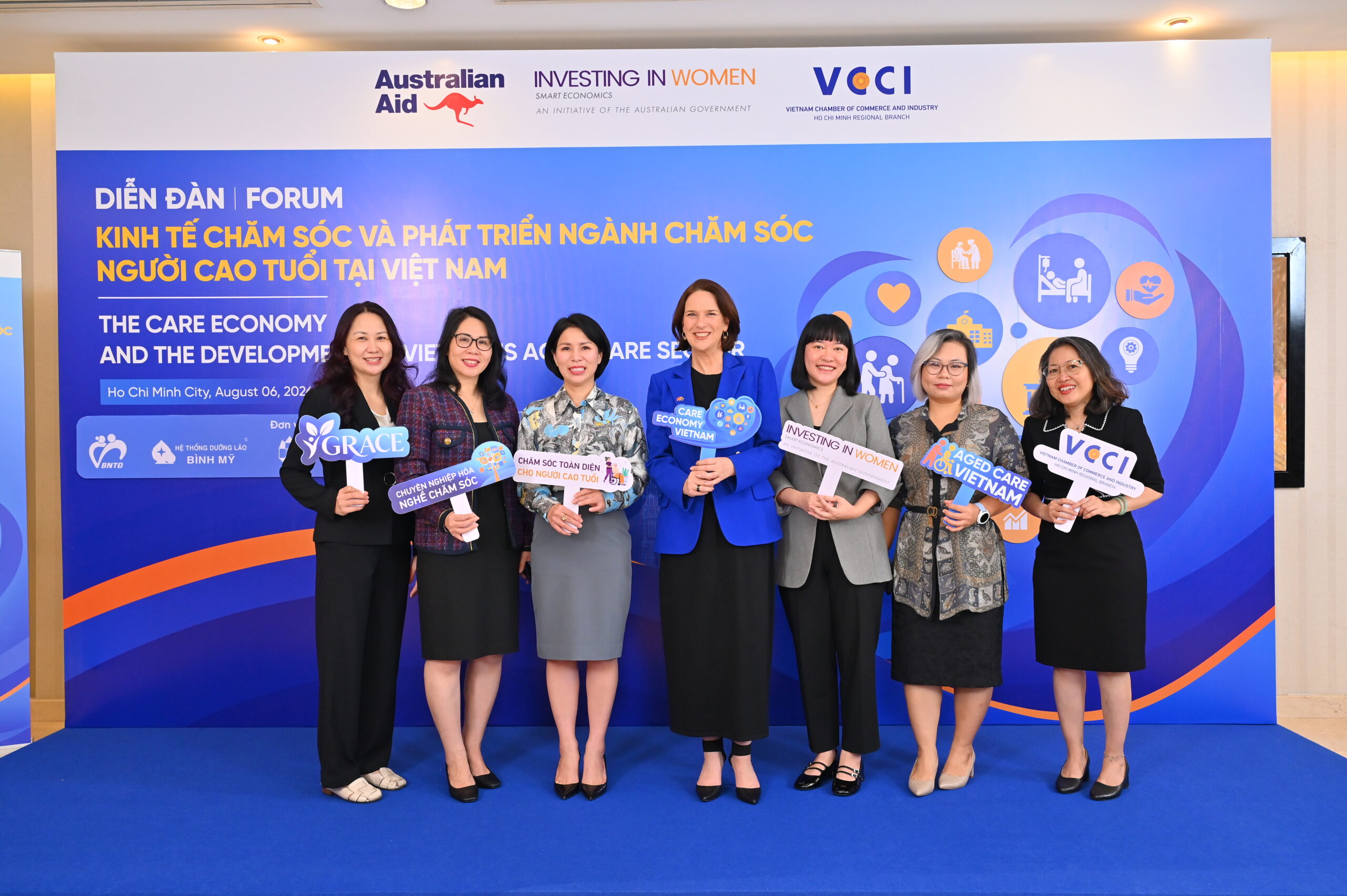
HO CHI MINH CITY, 6 August, 2026 — Today, the Vietnam Chamber of Commerce and Industry – Ho Chi Minh City Regional Branch (VCCI-HCM), with support from Investing in Women (IW), an initiative of the Australian Government, held the “Forum on the Care Economy and the Development of Vietnam’s Aged Care Sector.” The event brought together delegates from the National Assembly’s Committee for People’s Aspirations and Supervision, the ministries responsible for health and education and training, local government agencies, vocational education and training institutions, businesses, aged care facilities, and international development experts. The Forum provided an open platform for public–private dialogue built around two core pillars: turning the pressures of population ageing into opportunities offered by the Silver Economy, and removing legal bottlenecks facing the non-medical aged care workforce.
Seizing the policy window and opportunities arising from Vietnam’s Silver Economy
Vietnam is entering a phase of population ageing at one of the fastest rates in the world, creating a distinctive development challenge as the pace of population ageing is outstripping the pace of economic development. According to the Vietnam Population Projections 2024–2074 (National Statistics Office and UNFPA, 2025), by 2034 Vietnam will officially become an aged society, with 14% of its population aged 65 or above. The population aged 80 and above is projected to triple by 2050, placing unprecedented pressure on the social security system and families. More concerning still, although life expectancy in Vietnam has risen to 74.7 years, healthy life expectancy remains at 65.4 years, leaving older persons facing nearly 10 years of declining health.
However, the Forum offered a new perspective: population ageing should not be viewed solely as a fiscal burden, but also as a service market with significant untapped potential—the Silver Economy. Globally, this market is estimated to be worth more than USD 4 trillion by 2026. To turn this pressure into an opportunity, Vietnam has moved swiftly to lay an institutional foundation through a coherent body of legal instruments. The core direction set out in the Party’s Resolution No. 42-NQ/TW of the Central Executive Committee of the Vietnam Communist Party on the continued renovation and enhancement of the quality of social policies, including social security for older persons, has been institutionalized through the 2025 Law on Population; Decree No. 168/2026/ND-CP on strengthening home-based and community-based care; Decision No. 1116/QD-TTg on comprehensive care beyond medical services; Resolution No. 72-NQ/TW on mobilising private-sector resources; and, notably, Decision No. 383/QD-TTg, the first legal instrument to formally introduce the term “Silver Economy” into Vietnam’s legal framework.
Removing institutional bottlenecks and professionalising the care workforce
At the Forum, delegates and experts focused on two key groups of solutions to advance the aged care services sector. The first group of solutions focuses on removing institutional barriers and unlocking private capital as well as international investment. First, from an institutional and investment perspective, while the enabling legal framework is taking shape, major barriers remain, including the lack of specific mechanisms relating to finance, land, licensing procedures, and preferential credit. To unlock private capital and attract international investment funds, representatives of National Assembly bodies, economic experts, and businesses stressed the need to strengthen the implementation of the 2025 Law on Population, the Resolution No. 42-NQ/TW, as well as scale up community-based and day-care models suited to local contexts. Drawing on international experience, Japanese expert Mr. Osamu Nimonjiya from Asian Human Power Networks proposed a “Vietnamese Hardware + Japanese Software” model for building an Integrated Community Care System, with the core aim of supporting independence and protecting the dignity of older persons.
The Forum also discussed a second group of solution on professionalising the non-medical aged care workforce as a critical factor in determining service quality. The occupation of non-medical aged care worker still lacks formal recognition, a national occupational code, and a national competency standards framework. As a result, caregivers are often treated as part of the informal workforce, training institutions cannot issue appropriate occupational qualifications, and businesses remain reluctant to expand operations as they are unable to find qualified employees. To help address this issue, GRACE (Gender-Responsive Innovations for Equitable Aged Care) Project, implemented by VCCI-HCM with support from IW—has produced a compelling body of practical evidence. Through a micro-credential model, the project successfully trained 29 trainers using Australian-standard training approaches. The project also standardised the competencies of 206 learners, increasing their occupational confidence score from 2.42 to 4.04 out of 5. This impact not only helps address workforce shortages but also contributes to reducing the disproportionate responsibility of unpaid care work borne by women, transforming care work – long regarded as unskilled – into a recognised, skilled, and fairly-remunerated profession for everyone. This evidence provided the basis for VCCI-HCM to propose that the Ministry of Education and Training consider formally recognising the occupation and introducing a national occupational code, enabling workforce standardization nationwide.
Underscoring the urgency of completing the institutional framework, Ms. Bui Thi Ninh, Deputy General Director of the Vietnam Chamber of Commerce and Industry – Ho Chi Minh City Regional Branch (VCCI-HCM), stated:
“The concept of the Silver Economy marks an important shift in mindset: population ageing is not a burden but a new market and a new driver of growth. For Vietnam, the Silver Economy opens up two parallel opportunities: expanding the market for businesses in labor-intensive care services, creating sustainable and quality jobs, and supporting women in rebalancing unpaid care and economic opportunities, when they have access to professional care services. Vietnam has built an enabling policy foundation for the Silver Economy and a comprehensive aged care system through the 2025 Law on Population, Decree No. 168/2026/ND-CP, and Decision No. 1116/QD-TTg, providing an important launchpad for an older-person-centered approach.
Building on this institutional foundation, VCCI expects to work with stakeholders over the next five to ten years to build a Silver Economy ecosystem based on three pillars: a care workforce supported by standardized occupational codes; a diverse, high-quality private care services market; and effective public–private cooperation mechanisms. Professionalising care work not only addresses economic and labour supply-and-demand challenges, but also represents a strategic investment in gender equality and sustainable social protection.”
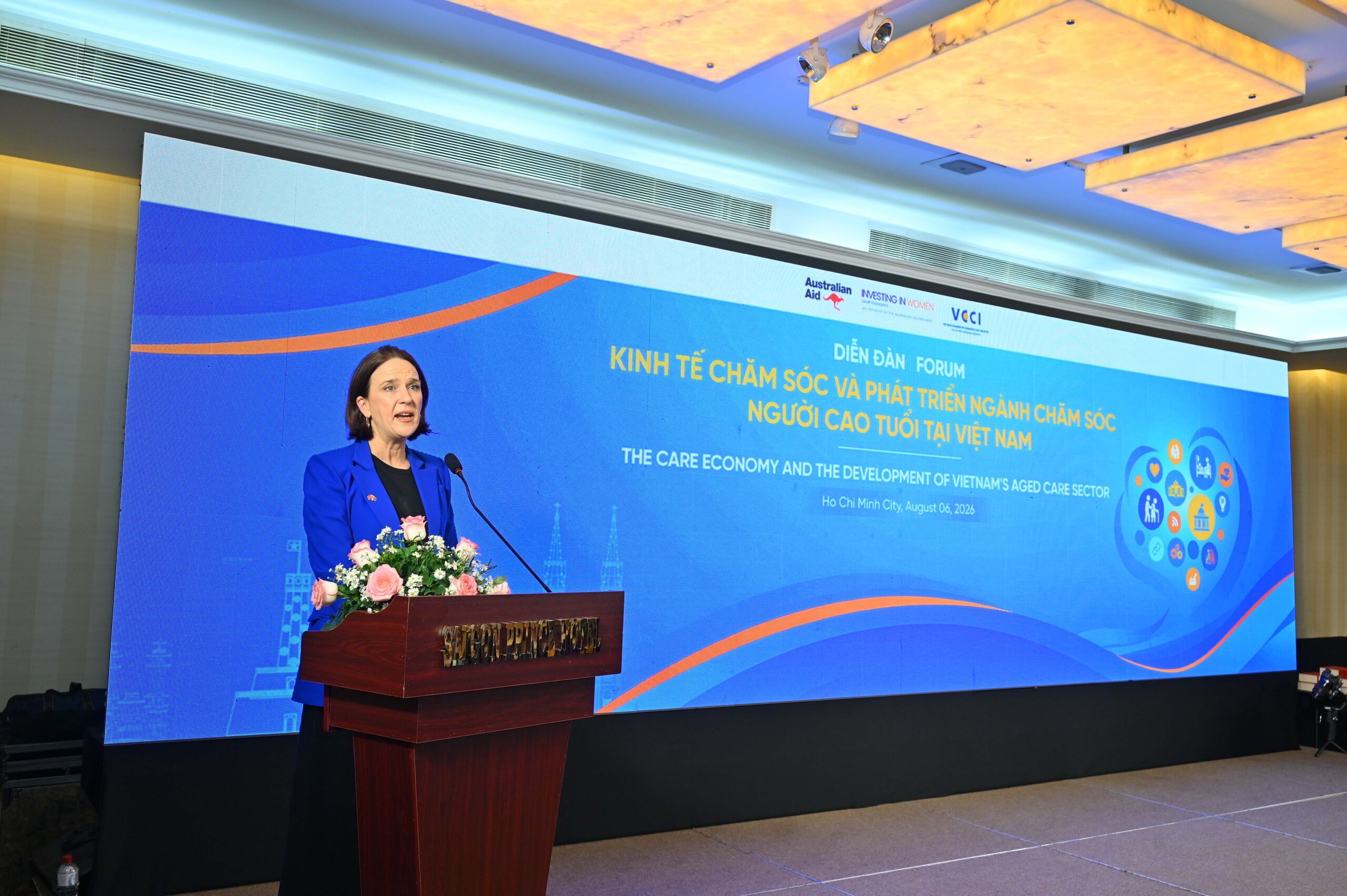
Reaffirming the Australian Government’s commitment to working with Vietnam in strengthening the care economy, Ms. Kate Wallace, Australian Consul General in Ho Chi Minh City, remarked:
“When care work is recognised and valued, everyone benefits. By investing in a professional non-medical caregiving workforce, we can improve the wellbeing of older persons, create quality jobs, and support women in rebalancing care responsibilities. Australia is proud to support Vietnam in this journey through the GRACE project, where we contribute to Vietnam’s efforts to build a professional, inclusive, and sustainable aged care sector.”
The Forum concluded with strong consensus on a 2026–2030 Action Roadmap aimed at establishing a legal framework and occupational code for the non-medical care (NMC) workforce, piloting training under the micro-credential model, standardizing quality, and scaling up models that connect labour supply and demand. At the closing ceremony, the representatives of VCCI-HCM affirmed their commitment to continue working with the Government and the business community to turn policy recommendations into concrete action, helping establish the Silver Economy as a pillar of sustainable, inclusive and people-centred development in Vietnam.
Media Contact
VCCI-HCM Office
171 Vo Thi Sau Street, Xuan Hoa Ward, Ho Chi Minh City
Tel: +84 906 821 203 (Ms. Phuong Thao)
Email: phuongthao@vcci-hcm.org.vn