




Before joining VGEM, Lư Kỳ Quang was already familiar with concepts of gender equality. He had completed an intensive gender training program at the Vietnam Women’s Academy, has supported various community initiatives promoting gender equality, and has been following ECUE and VGEM’s work for some time.
Through his work with NGOs, he regularly engaged with women, children, and young people, introducing basic concepts about gender, stereotypes, and equal opportunities. For example, in Đắk Lắk, he raised funds to build a small bookshelf and introduce gender-sensitive books to high school students. These experiences strengthened his commitment to gender equality, but his initiatives still focused largely on communication and awareness-raising.
Joining ECUE-VGEM’s courses and Community of Practice opened a deeper layer for Quang. Rather than simply providing more information about gender equality, the experience encouraged him to examine how gender shapes participation, power, and opportunity across different areas of life.
Moving Beyond Gender Communication
Through VGEM’s Gender Mainstreaming course and other learning opportunities, Quang began to see gender not only as a topic to explain, but as a lens for understanding participation, power, and opportunity across different fields.
This shift became clear when he worked with FPT Green Environment Club, a student-led environmental group. Instead of treating gender as a separate issue, Quang encouraged members to consider who participates in environmental activities, who is represented in STEM and STEAM spaces, and how young women can be supported to enter fields often perceived as male-dominated.
Gender equality became more than a message. It became a way of analysing program, communities, and systems.
This transition was important for Quang. Previously, much of his work had focused on helping others understand gender concepts. Through VGEM, he began applying gender perspectives across issues that are not always immediately associated with gender equality, including environmental action, student leadership, and access to opportunities. In doing so, he moved from communicating about gender to integrating gender into how programmes and initiatives are designed
Looking Inward, Not Just Outward
A deeper transformation came through the Philosophy of Gender course. What initially felt like an abstract subject became an opportunity to reflect on his own thinking and practice. The course helped him recognise how his own perspectives, language, and approaches were shaped by underlying assumptions.
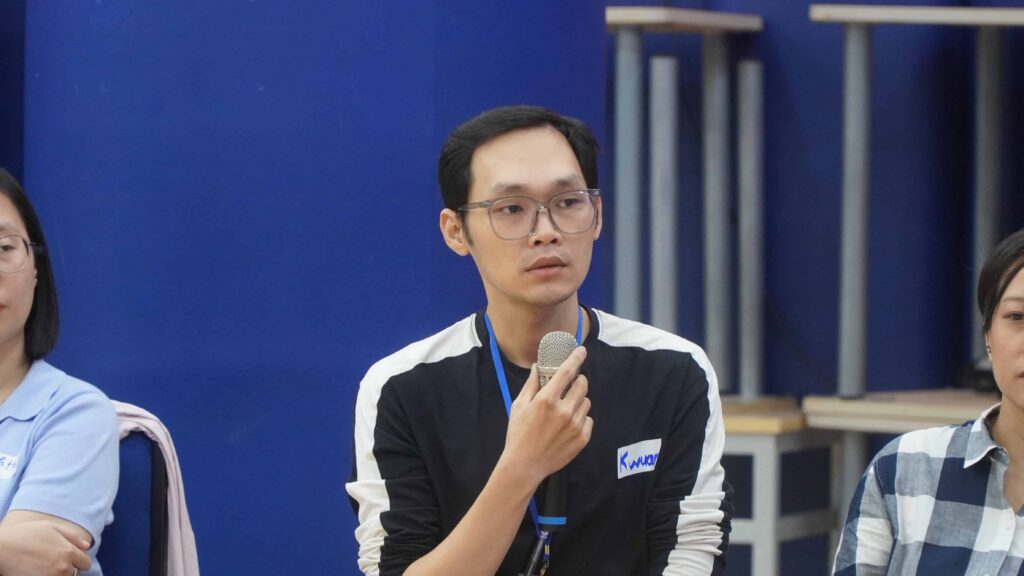
Quang participates in the VGEM learning event 2026 in Ho Chi Minh City. (Photo from ECUE-VGEM)
“Sometimes, even I can fall into essentialist ways of thinking, or into assumptions that treat gender as fixed, identical, binary, or neutral. But now I can better recognise where my own frame is located—where my framework and my consciousness are coming from,” Quang shared.
As a result, he revisited the lesson plans and activities he had developed over the years. He began identifying places where content could be made more gender-sensitive and where “neutral” approaches might unintentionally exclude or oversimplify different experiences.
Learning as a Continuous Reflective Practice
For Quang, the most significant change was not learning entirely new concepts but developing the habit of critical self-reflection. Gender work became more than supporting others to change; it became an ongoing process of examining his own language, methods, and potential impact.
His story highlights an important pathway of change within VGEM. When individuals who are already committed to gender equality are exposed to deeper learning, critical reflection, and a community of peers, they do not simply gain more knowledge. They become more thoughtful practitioners, capable of applying gender perspectives across different fields while continuously challenging their own assumptions.
For Quang, learning is no longer a destination. It is a practice of looking inward, asking better questions, and becoming more intentional about the change he hopes to create.